

Automatic AI context
Basedash automatically provides the AI with comprehensive context about your data sources, including:- Data source structure: Table names, column names, and data types from all connected databases and warehouses
- Table and column descriptions: Any existing comments or descriptions from your source databases (PostgreSQL and Snowflake comments, BigQuery descriptions)
- dbt descriptions: If you use dbt, the column descriptions it persists to your warehouse are included the same way
How AI interprets your data
Basedash performs automatic pre-processing when you connect your data sources to understand the structure of your schemas, tables, and columns. The AI can analyze data types, relationships, and basic metadata to generate queries and visualizations. However, custom context provides the business intelligence that goes beyond the technical structure. It helps the AI understand:- How your organization operates and what metrics matter most
- What your data actually represents in business terms
- Internal terminology and KPIs specific to your company
- The context and meaning behind complex data structures
How it works
Custom context is automatically considered by the AI whenever you create charts, chat, or automations in Basedash. Global context applies to every conversation within your organization. You can also add group context to control how the AI works for different teams. Data source, schema, table, and column-level context is used when that specific data is referenced by the AI.Accessing custom context
Global context
Global context applies to every AI interaction in the organization. Admins edit it in Settings → AI context, in the Global context section. Include information about your company, how your data is structured, or how you calculate metrics. Changes save automatically.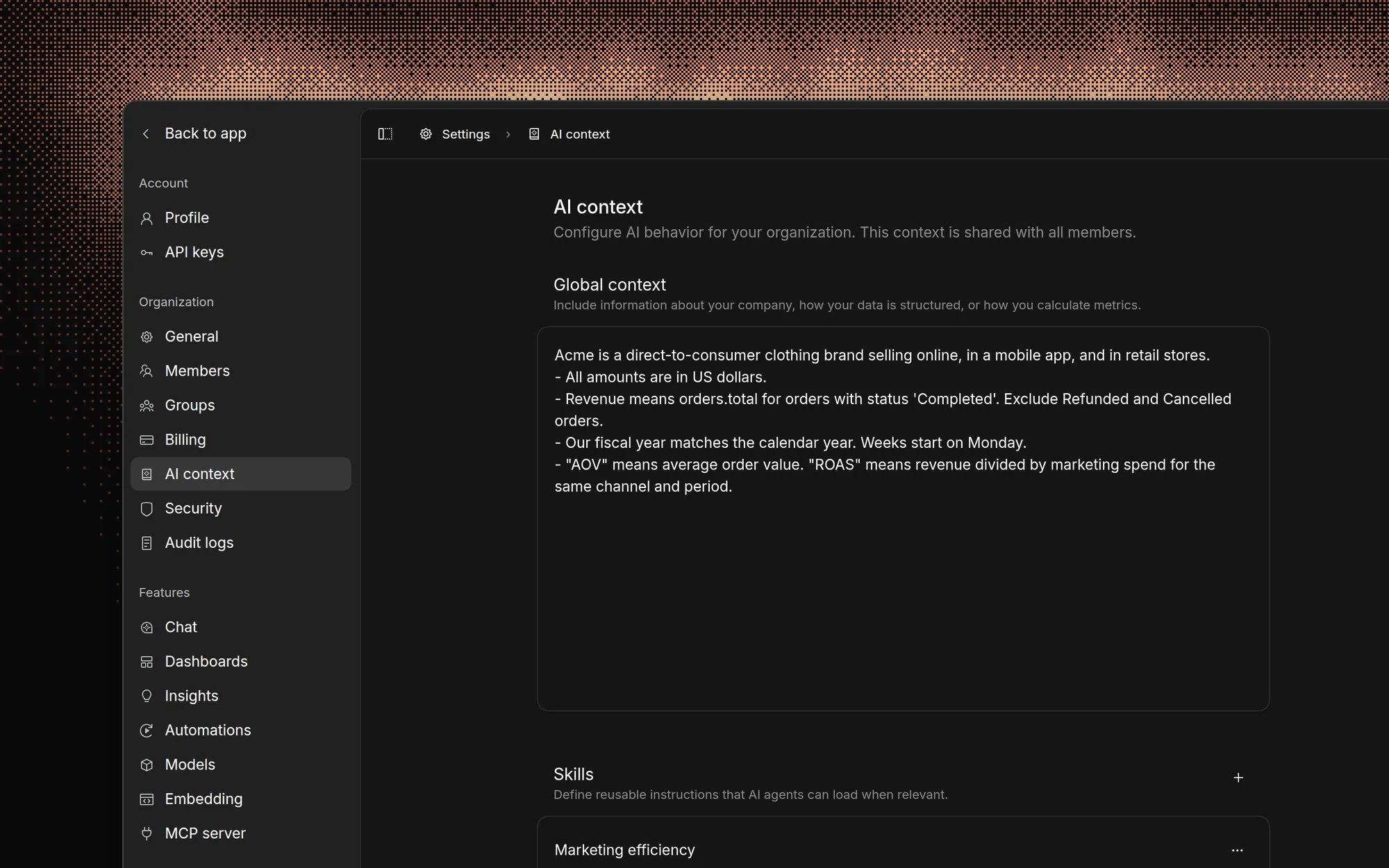
Skills
Skills are reusable sets of instructions that agents load only when they’re relevant, such as how to run a retention analysis or how the finance team defines revenue. Unlike global context, which is always loaded in full, each agent sees the list of skills and reads a skill’s instructions on demand. Admins manage skills in Settings → AI context. See Skills for how to create skills, examples, and limits.Group context
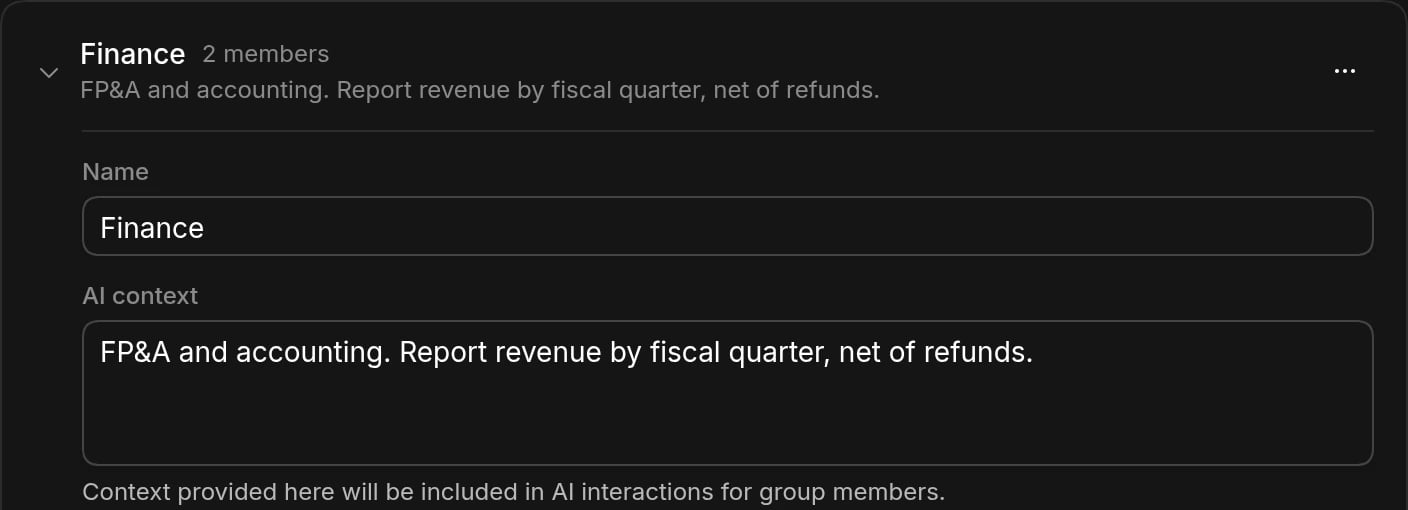
Group context applies to members of a specific group. This is useful when different teams need the AI to behave differently, such as:- Finance: Explain reporting conventions and preferred accounting terminology
- Support: Explain ticket lifecycle, common issue categories, and internal abbreviations
- Sales: Define pipeline stages and how to interpret deal status fields
Personal context
Personal context applies only to you, in the current organization. Use it for preferences, shorthand, or recurring instructions, like “Show currency in EUR” or “Keep summaries to three bullet points.” To edit it, open Settings → Profile and fill in Personal AI context. You can also ask chat to remember a preference, and it updates your personal context for you.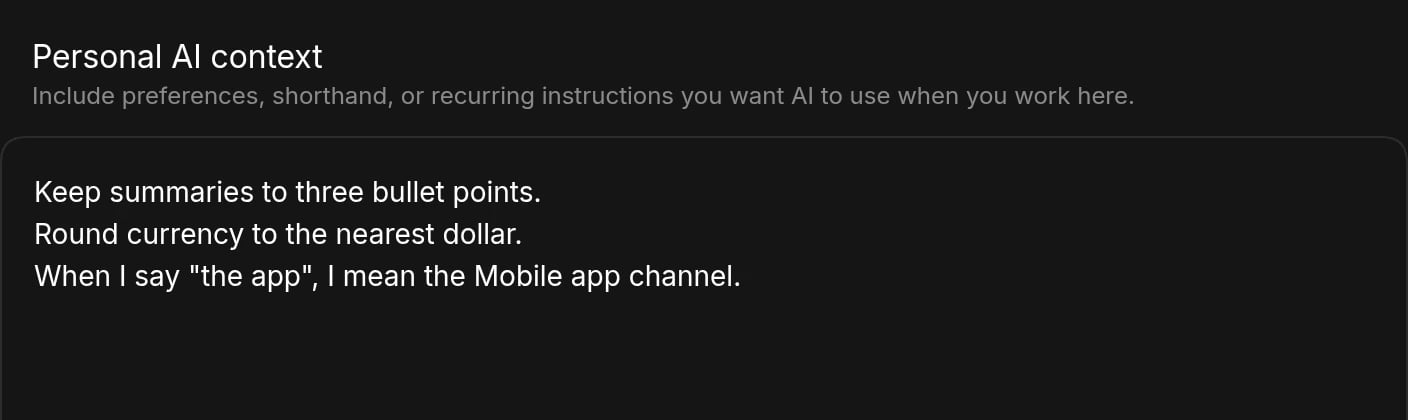
Context in chat
In the chat input, click the + button. Admins see an AI context option that opens the organization’s AI context settings. Everyone can upload files to give the AI extra context for that chat.Data source context
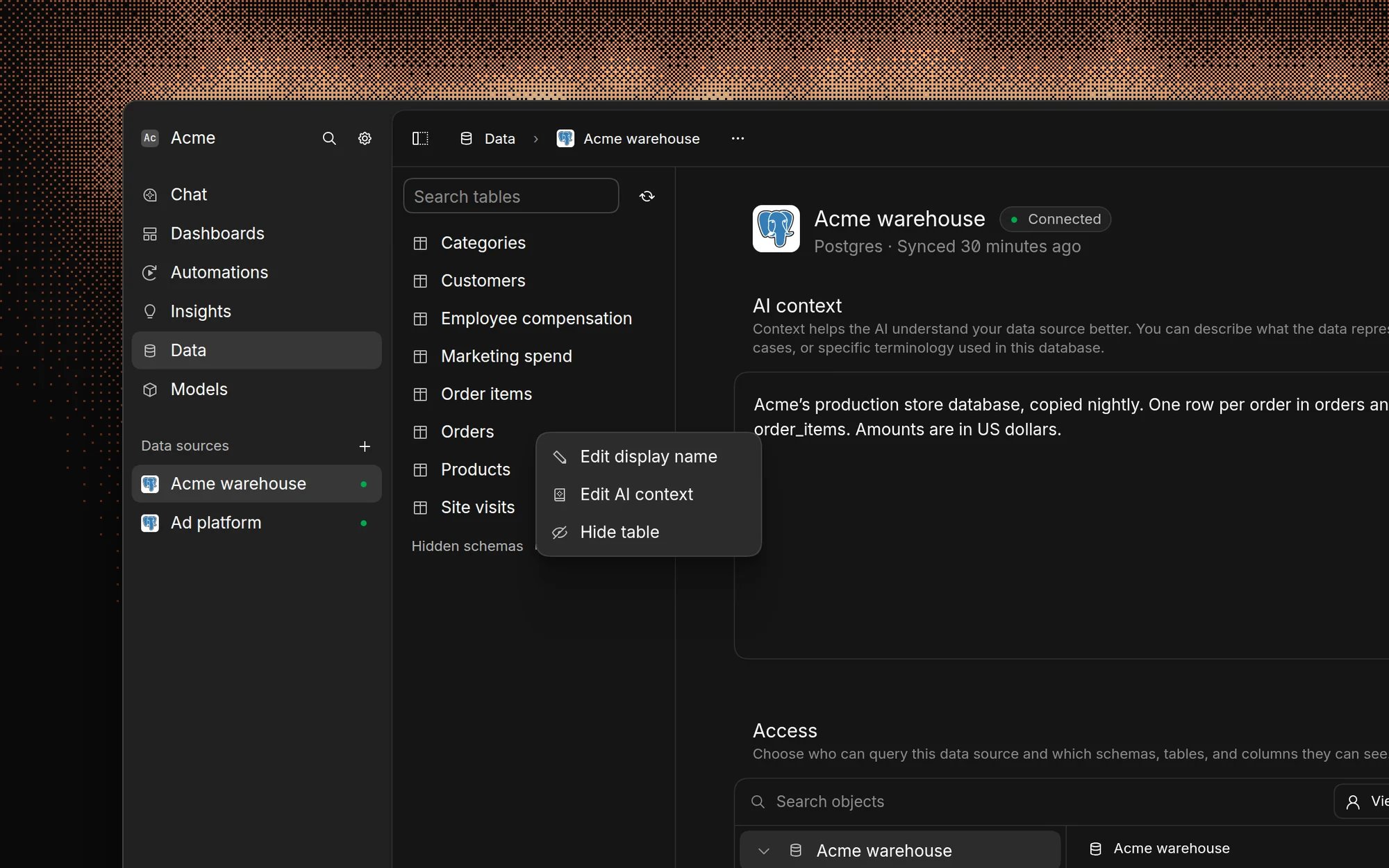
You can also add context tied to a specific data source, schema, table, or column.- Navigate to the Data page
- Right-click on a data source, schema, table, or column
- Select “Edit AI context”
Limits
Global context and data source context can each be up to 50,000 characters.
Group context, personal context, and insights context
can each be up to 20,000 characters.
Best practices
Start with global context
We recommend beginning with global context as one of your first setup steps. This provides the AI with fundamental understanding of your business, terminology, and key metrics.Define internal terminology
Global context is a great place to define internal terminology. This helps the AI understand your business, terminology, and key metrics. Use custom context to explain:- Internal KPI terminology: How your organization names and discusses important metrics
- User terminology: How you refer to different user types (e.g., “signups,” “active users,” “premium customers”)
- Business jargon: Company-specific terms and definitions
Getting started
We recommend adding custom context as part of your initial Basedash setup. This ensures the AI has the right context from the beginning, leading to more accurate and relevant responses. For step-by-step guidance, see our getting started guide which includes custom context setup as part of the recommended workflow.Examples
Organization context
Schema context
Group context
Column context
FAQ
Should I use AI context, a skill, or a model?
Should I use AI context, a skill, or a model?
Use AI context for facts the AI should always know, like what your company
does and what your terms mean. Use a skill for
instructions that only matter for some requests, like how to run a retention
analysis. Use a model for calculations that must come
out the same every time, like how revenue is computed.
Does AI context apply in Slack, the MCP server, and automations?
Does AI context apply in Slack, the MCP server, and automations?
Yes. Global context applies wherever the AI answers: chat, Slack, the MCP
server, and automations. Group and personal context
come from the person asking, so they apply when Basedash can match the
message to a member. Automations use the context of the member who created
them. Insights use global context plus the insights
context from Settings → Insights, not group or personal context.
I'm in several groups. Whose group context applies?
I'm in several groups. Whose group context applies?
All of them. The AI gets the context of every group you belong to.
Who can edit table and column context?
Who can edit table and column context?
Admins, and members who can query the data source, can edit schema, table,
and column context from the Data page. View-only members can’t. Global
context and context on the data source itself are admin-only.
Does Basedash use the comments in my database?
Does Basedash use the comments in my database?
Yes, for PostgreSQL column comments and BigQuery and Snowflake column
descriptions. They’re synced with the schema and shown as a read-only
Description from database next to the context you add, so you don’t need
to copy them over.
Does chat ask before it changes AI context?
Does chat ask before it changes AI context?
No. When you ask chat to remember something, it updates your personal
context right away. Admins can also ask it to update global context or table
and column descriptions. Every change is recorded in audit
logs, and you can edit or remove it in
settings.